Operation Endgame: How Federal Agents and European Allies Brought Down a Global Ransomware Syndicate
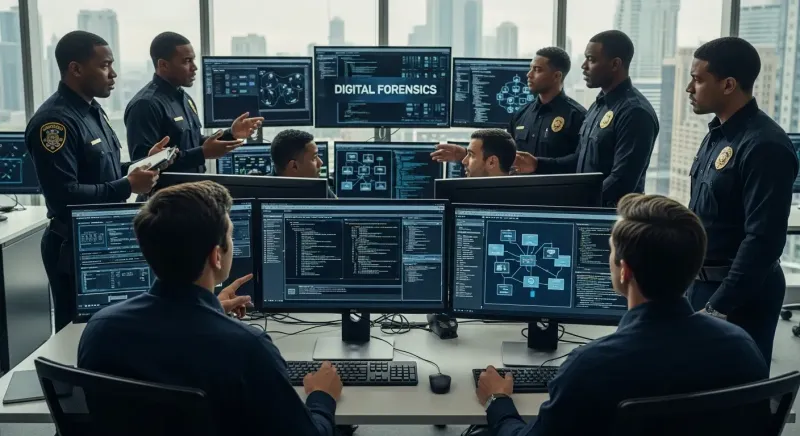
Photo: FBI cybercrime investigators digital forensics server room law enforcement, via computerforensicslab.co.uk
For the victims, the attack arrives without warning. One moment, a hospital administrator in Ohio is pulling up patient records. The next, every screen on the network displays the same message: your files have been encrypted, a cryptocurrency ransom is demanded, and a countdown clock is ticking. Behind that message sits an entire criminal enterprise — developers, affiliates, negotiators, money launderers — operating with the organizational sophistication of a midsize technology company.
Dismantling that enterprise requires something equally sophisticated on the other side of the equation. The coordinated law-enforcement campaigns that have increasingly targeted ransomware infrastructure over the past several years represent some of the most technically demanding criminal investigations ever conducted. Understanding how they work illuminates both the scale of the threat and the remarkable ingenuity deployed to counter it.
The Ransomware-as-a-Service Model: A Criminal Franchise
To appreciate how these takedowns are structured, it helps to understand what investigators are actually targeting. Modern ransomware operations rarely function as monolithic criminal organizations. Instead, they operate on a franchise model known as ransomware-as-a-service, or RaaS.
In this arrangement, a core development team — sometimes numbering fewer than a dozen individuals — writes and maintains the ransomware code and manages the supporting infrastructure: encrypted communications channels, victim-negotiation portals, cryptocurrency payment systems, and data-leak sites used to pressure victims into paying. These developers then recruit "affiliates" — independent criminal contractors who carry out the actual intrusions. Affiliates typically retain 70 to 80 percent of any ransom collected; the remainder flows back to the core group.
This structure creates a deliberate separation between the people who build the weapon and the people who deploy it. It complicates attribution, distributes legal risk, and allows operations to scale rapidly. Groups operating under this model have included LockBit, BlackCat (also known as ALPHV), and Hive — all of which have been subjects of major law-enforcement actions in recent years.
The Investigative Playbook: Peeling the Onion
Investigators pursuing ransomware networks face a layered anonymization problem. Operators communicate through encrypted messaging applications, route their internet traffic through multiple VPN services and the Tor anonymity network, and conduct all financial transactions in cryptocurrency — most commonly Bitcoin or privacy-focused alternatives such as Monero.
Peeling back those layers requires a combination of digital forensics, financial intelligence, and old-fashioned human intelligence.
Cryptocurrency tracing has matured dramatically as an investigative discipline. While many people assume cryptocurrency transactions are untraceable, Bitcoin's underlying blockchain is a permanent, public ledger. Specialized blockchain analytics firms — Chainalysis and Elliptic are among the most prominent — provide law-enforcement agencies with software capable of following cryptocurrency flows across thousands of wallet addresses, identifying patterns that suggest consolidation, and flagging transactions that touch regulated exchanges where identity verification is required. When ransomware proceeds eventually reach a centralized exchange, investigators can serve legal process to obtain the account holder's identity documents.
Infrastructure analysis focuses on the servers that host ransomware control panels, negotiation portals, and leak sites. While operators take significant precautions, mistakes accumulate over time. A server configured without full anonymization, a domain registered with a real email address years before the criminal operation began, or an IP address reused across multiple projects can create threads investigators pull carefully until the entire network unravels.
Insider information and defectors play a larger role than the public record typically reflects. Criminal organizations experience internal disputes, unpaid affiliates, and disgruntled former members. Law-enforcement agencies actively cultivate these sources, and tip-offs from within criminal communities have contributed to several high-profile takedowns.
International Architecture: Why Cooperation Is Non-Negotiable
Ransomware operations are inherently multinational. Core developers may reside in Eastern Europe or Russia. Affiliates operate from dozens of countries. Infrastructure is hosted across jurisdictions specifically chosen to complicate legal process. Victims are concentrated in the United States, Western Europe, and Australia — precisely because those economies have both the wealth to pay significant ransoms and the critical infrastructure most vulnerable to disruption.
This geography makes unilateral action by any single nation largely ineffective. The FBI cannot arrest a suspect in a country with which the United States has no extradition treaty. It can, however, coordinate with Europol — the European Union's law-enforcement intelligence agency — to simultaneously execute search warrants, seize servers, freeze cryptocurrency wallets, and make arrests across multiple jurisdictions on the same day.
This synchronization is critical. If operators receive any warning that law enforcement is closing in, they can migrate infrastructure, alert affiliates, and destroy evidence within hours. The element of surprise, executed simultaneously across borders, is often what determines whether a takedown produces arrests or merely temporary disruption.
Europol's European Cybercrime Centre (EC3) serves as the operational hub for many of these coordinated actions, aggregating intelligence from member states and managing the logistics of simultaneous multi-country operations. The FBI's Cyber Division contributes both technical resources and jurisdiction over the substantial share of victims located in the United States.
What Takedowns Actually Accomplish — and What They Don't
Law-enforcement announcements following major ransomware takedowns tend to emphasize the dramatic: servers seized, suspects arrested, cryptocurrency recovered. These outcomes are genuinely significant. Server seizures can yield decryption keys that allow existing victims to recover their data without paying a ransom — a direct, tangible benefit that the Justice Department has increasingly prioritized.
However, the cybersecurity community is candid about the limitations of the disruption model. Criminal networks that lose their infrastructure can reconstitute under new branding with relative speed. Several groups have re-emerged under different names following takedowns, recruiting affiliates back through dark-web forums within weeks. The arrest of core developers is more consequential — technical expertise is harder to replace than servers — but developers in non-extradition jurisdictions remain largely beyond reach.
The more durable impact of these operations may be psychological and economic. Seizure of cryptocurrency assets eliminates the financial reward that sustains the enterprise. Public exposure of operator identities — even without arrests — can destabilize trust within criminal networks and make recruitment more difficult. And the demonstrated capability to penetrate these organizations, however briefly, imposes ongoing operational security costs that reduce efficiency and profitability.
What This Means for Potential Victims
For the hospitals, school districts, municipal governments, and private businesses that constitute the primary target pool for ransomware operators, the existence of active law-enforcement operations is reassuring but not sufficient protection. Investigators consistently find that most successful ransomware intrusions exploit a small set of preventable vulnerabilities: unpatched software, weak or reused credentials, and the absence of multi-factor authentication on remote-access systems.
The FBI and the Cybersecurity and Infrastructure Security Agency (CISA) both maintain updated guidance on ransomware prevention, and CISA operates a free vulnerability scanning service for critical infrastructure operators. Reporting ransomware incidents to the FBI's Internet Crime Complaint Center (IC3.gov) — even when an organization chooses not to pay a ransom — contributes to the intelligence picture that makes future takedowns possible.
The machinery of international cybercrime enforcement is genuinely impressive. So is the machinery of the criminal enterprises it pursues. For now, the contest between them continues — measured in seized servers, frozen wallets, and, for victims, the agonizing silence of an encrypted network waiting for someone to intervene.